

Invoke the Developer Tools Menu
You can invoke the Developer Tools menu in several ways:- Remote Control: On the directional pad, press and hold the Center button for a second; then (still holding down Center), press the Down button too. Hold both buttons for about 3-4 seconds. Then release both buttons and press the remote’s Menu button. (If this doesn’t work, try holding Center and Down simultaneously instead of staggered.)
- Amazon Game Controller: Press and hold the A and Y buttons together (simultaneously) for 5 seconds; then release the buttons and press the controller’s menu button.
-
Android Debug Bridge: If adb is enabled on the Fire TV and a computer is connected, you can run the following command to invoke the dialog box:
adb shell am start com.amazon.ssm/com.amazon.ssm.ControlPanelTo use the adb command, you’ll need to enable adb debugging in the Fire TV Settings, have Android Studio installed, and know your Fire TV’s IP address (go to Settings> My Fire TV (or Device & Software) > About > Network). Open a terminal window on your computer and connect through ADB with this command:adb connect 123.456.7.89:5555, replacing123.456.7.89with your own IP address. Leave5555as the port. Read more details here: Connect to Fire TV Through ADB.
 The various panels are explained:
- System X-Ray
- Advanced Options
- Snapshot
- Record & Share
- Safezone
- Developer Options
- Network Proxy
- Clear Credential Storage
- Launch Network Advisor
System X-Ray
System X-Ray gathers instantaneous system metrics and displays on top of the screen as an overlay. When toggled on, the overlay will always be visible on the screen.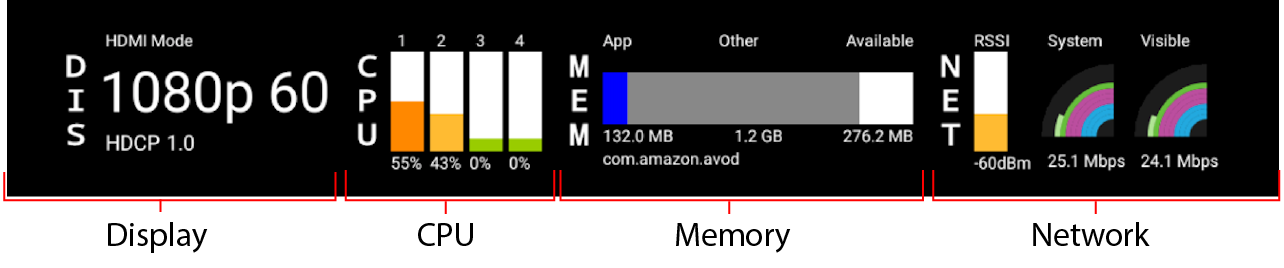 The System X-Ray overlay contains details about the following:
- Display
- CPU
- Memory
- Network
Advanced Options
Advanced Options enables multimedia information to appear when Android MediaCodec APIs are in use. When you switch this option on and then play media, an additional display (titled “MUL” for Multimedia (audio and video) and “AUD” for Audio Focus) appears on the right. Information displayed in the Multimedia panel is divided into three sections: Audio, Video, and Audio Focus.
AUDIO
| Property | Description |
|---|---|
| Codec | Audio codec format |
| Hardware Accelerated | If audio playback is hardware accelerated |
| Input Bitrate | Audio input bitrate |
| Secure | If secure or not |
VIDEO
| Property | Description |
|---|---|
| Codec | Video Codec Format |
| Hardware Accelerated | If video playback is hardware accelerated |
| Input Bitrate | Video Input Bitrate |
| Secure | If video is secure or not |
| Frames Dropped | Frame drop count |
| Resolution | Playback resolution |
| Frame Rate | Playback frame rate |
| Color Standard |
AUDIO FOCUS
| Property | Description |
|---|---|
| Package | Package name of the audio playback |
| Gain | Audio focus gain implication |
| Loss | Audio focus loss implication |
| F/U/C | Flag / Usage / Content
|
AUDIOFOCUS_NONE: noneAUDIOFOCUS_GAIN: gainAUDIOFOCUS_GAIN_TRANSIENT: g_trAUDIOFOCUS_GAIN_TRANSIENT_MAY_DUCK: gtmdAUDIOFOCUS_GAIN_TRANSIENT_EXCLUSIVE: gtreAUDIOFOCUS_LOSS: lossAUDIOFOCUS_LOSS_TRANSIENT: l_trLOSS_TRANSIENT_CAN_DUCK: ltcdUNKNOWN: unkn
Snapshot
Snapshot provides a way for users to gather instantaneous all metrics information throughadb command. Whenever you input the following command, metric information will display in the command line.
Record & Share
Record & Share stores instantaneous metrics about CPU, memory, network, and multimedia into a database as historical data. Although the same information is displayed graphically in real-time through the System X-Ray overlay, Record & Share takes this information and stores it into a history that you can dump to the command line. To use Record & Share, first toggle the Record & Share setting in the Developer Tools Menu to On. You’re then prompted to select the Record Settings: These properties control the following:
- Interval: The time between two recordings: 2 seconds, 4 seconds, 8 seconds, 16 seconds, or 32 seconds.
- Duration: How long the data gets stored in the database: 1 hour, 2 hours, 4 hours, 8 hours, or 16 hours.
- Timestamp
- cpu0
- cpu1
- cpu2
- cpu3
- Timestamp
- Total_Memory
- Available_Memory
- Active_Memory
- Foreground_App_Memory
- Foreground_App_PackageName
- Timestamp
- RSSI
- Download_Speed
- Foreground_App_Download_Speed
- Foreground_App_PackageName
- Timestamp
- AudioCodec
- AudioInputBitrate
- AudioAccelerated
- AudioSecure
- VideoCodec
- VideoInputBitrate
- VideoAccelerated
- VideoSecure
- VideoResolution
- VideoFramerate
- VideoFramedropped
To check available options, pass the
-help parameter:

Safezone
Some TVs use overscan with their display. Overscan means the TV displays some information off the edges of the visible screen (to accommodate discrepancies in monitors). Do not display important information in the overscan areas. To make the overscan areas visible, you can turn the SafeZone switch to On. This makes the overscan areas apparent so you can avoid displaying any information in these areas. Fire TV Stick (2nd Gen) does not include screen size calibration. If the screen display doesn’t fit correctly on the TV screen, the overscan area might not show accurately.
