
Alexa+ MCP QuickStart Guide
This guide walks you through the prerequisites, requirements, and onboarding steps to connect your MCP server to Alexa+. For a conceptual overview of the integration architecture, see the Alexa+ MCP Toolkit Overview.
Before you begin, complete the steps in Set Up Your Development Environment.
MCP requirements for Alexa+
Make sure that your MCP server meets all the requirements in this section.
Technical requirements
-
Your MCP server must support Streamable HTTP. The MCP specification (2025-11-25) deprecated the standalone HTTP+SSE transport in favor of Streamable HTTP. If your MCP server currently uses the legacy SSE transport, you must migrate before connecting to Alexa+.
- If you expect to provide visuals, follow the MCP Apps standard. The MCP Apps SDK (@modelcontextprotocol/ext-apps) provides Agent Skills that guide AI coding agents to scaffold a new MCP App with an interactive UI from scratch, or convert an existing OpenAI App to use MCP Apps.
-
If you provide a text-only customer experience, proceed with existing server integration with Alexa+.
- Your MCP server must be accessible via a remote URL. During local development, you can use a tunneling service (such as cloudflared) to expose your server.
Authentication checklist
Discovery
-
Your MCP server returns
401 Unauthorized(without aWWW-Authenticateheader) for unauthenticated requests. -
Your server hosts a Protected Resource Metadata (PRM) document at the well-known URI according to RFC 9728.
-
Your auth server metadata is available at
/.well-known/oauth-authorization-server. -
code_challenge_methods_supportedmust be present and must includeS256. Account linking won't proceed without it.
Authorization Request
-
Required: Use OAuth 2.1 authorization code flow with PKCE (S256).
-
Required: Set the
resourceparameter to your MCP server's canonical URI. -
Required: Include scopes from
scopes_supportedin the PRM document. Omitscopeifscopes_supportedis undefined.
Token Request
-
Required: Include the
resourceparameter. -
Required: Include the PKCE
code_verifier.
Token Usage
-
Required: Send the Bearer token in the
Authorizationheader on every authenticated request. -
Required: Don't send the Bearer token in the query string.
Not Supported Yet
-
Dynamic Client Registration (DCR)
-
Client ID Metadata Documents (CIMD)
-
OpenID Connect (OIDC)
-
Step-Up Authorization.
-
WWW-Authenticateheader in 401 responses.
Performance
Your MCP server must meet a round-trip query response latency of less than 500 ms.
Security and data policies
Media (audio and video codecs)
Audio
- AAC LC, HE-AACv1, HE-AACv2 (enhanced AAC+), xHE-AAC, AAC ELD (enhanced low delay AAC), AMR-NB, AMR-WB, FLAC, MIDI, MP3, Opus, PCM/WAVE, Vorbis
Video
- H.264/AVC, H.265/HEVC, AV1, VP9 / VP8, MPEG4, MPEG2, JPEG, VVC, LCEVC, WebP
Connect your MCP server to Alexa+
You can onboard your MCP server to Alexa+ using the Alexa AI CLI. If you use an AI coding agent (Claude Code, Kiro, Codex, Cursor), install the Add-on Agent Skill for faster onboarding.
Step 1. Download and install CLI and authenticate
After you install CLI, authenticate with your Alexa developer account:
alexa-ai configure
This opens a browser for Login with Amazon (LWA) OAuth. Credentials are stored at ~/.alexa-ai/credentials. Use --no-browser for headless/SSH environments.
After you authenticate the CLI, choose whether to create your add-on using an AI agent, or create the add-on manually.
Path A: Add-on Agent Skill (recommended)
The Add-on Agent Skill guides your AI coding agent through the entire onboarding process. It works in Claude Code, Kiro, Cursor, VS Code Copilot, or any coding agent with shell access.
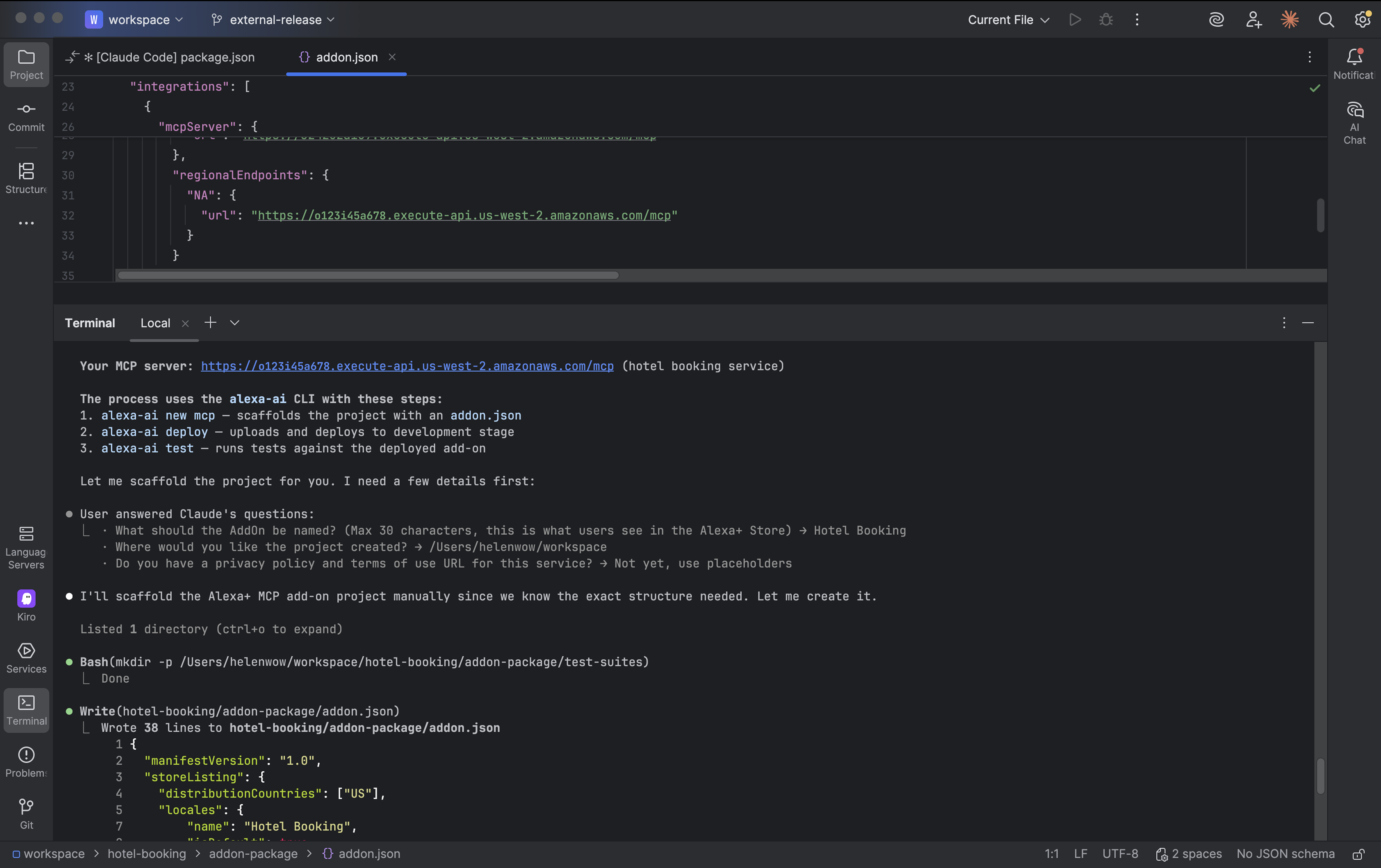
Step 2 — Prompt your coding agent
Open your coding agent and provide your MCP server URL:
I have an MCP server at https://mcp.example.com for a hotel booking service.

Help me create an Alexa+ add-on.
Step 3 — The skill walks you through the following phases
- MCP Introspection — Gets you authenticated with your developer account. Connects to your MCP server via JSON-RPC 2.0 (Streamable HTTP), discovers tools and resources, proposes an Add-on name. You confirm the name before proceeding.
- Add-on Scaffolding — Runs
alexa-ai new mcpto create the project structure, fills in capability-derived descriptions (shortDescription, fullDescription, examplePhrases) derived from your MCP server. You review and approve. - Media Assets & Compliance — Collects your privacy policy URL, terms of use URL, and required media assets (icon sizes + carousel image). Runs full validation.
- Deploy — Deploys your add-on to the development stage after you confirm. Returns your Add-on ID and enables testing in the web simulator.
- Submit — Submits your add-on for certification after you have tested your add-on in the web simulator.
Path B: Alexa AI CLI (manual)
If you prefer to work without an AI coding agent, use the Alexa AI CLI directly.
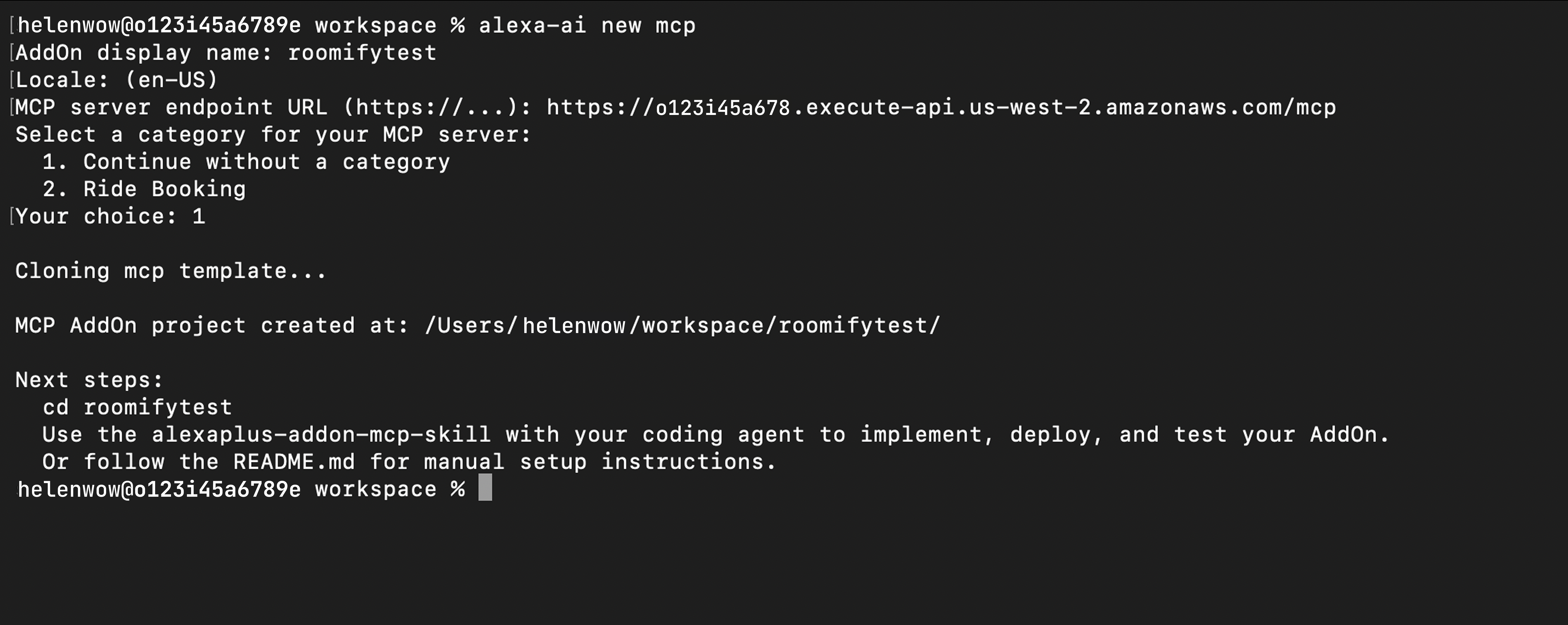
Step 2 — Scaffold your add-on
alexa-ai new mcp --name "Hotel Finder" --locale en-US --mcp-server-url "https://mcp.example.com"
This creates the project directory with addon-package/addon.json.
Step 3 — Edit addon.json
Open addon-package/addon.json and fill in:
shortDescription(≤123 characters)fullDescription(≤4000 characters)examplePhrases(3–4 phrases, each ≤200 characters)privacyAndCompliance.privacyPolicyUrlprivacyAndCompliance.termsOfUseUrlmediaAssets(see addon.json schema reference below)
Step 4 — Deploy
alexa-ai deploy
The CLI uploads your package, builds it, and deploys to the development stage. On success, it returns your Add-on ID and version.
addon.json schema reference
The addon-package/addon.json file uses the following schema:
{
  "manifestVersion": "1.0",
  "storeListing": {
    "distributionCountries": ["US"],
    "locales": {
      "en-US": {
        "default": "DEFAULT",
        "name": {
          "value": "Travel",
          "spokenForm": { "format": "ipa", "value": " " }
        },
        "shortDescription": "Search and book flights, hotels, and vacation packages",
        "fullDescription": "Search and book flights, hotels, and vacation packages. Compare prices across airlines and hotel chains. Book vacation packages.",
        "examplePhrases": [
          "Search hotels in Brisbane",
          "Search for flights from Seattle to Brisbane",
          "Find vacation packages to Hawaii"
        ],
        "privacyAndCompliance": {
          "privacyPolicyUrl": "https://example.com/privacy",
          "termsOfUseUrl": "https://example.com/terms"
        },
        "mediaAssets": {
          "icons": {
            "light": [
              { "size": "72x72", "uri": "https://example.com/icon-72x72.png" },
              { "size": "64x64", "uri": "https://example.com/icon-64x64.png" },
              { "size": "88x88", "uri": "https://example.com/icon-88x88.png" },
              { "size": "126x126", "uri": "https://example.com/icon-126x126.png" },
              { "size": "180x180", "uri": "https://example.com/icon-180x180.png" },
              { "size": "241x241", "uri": "https://example.com/icon-241x241.png" }
            ],
            "dark": []
          },
          "carouselImages": [
            { "uri": "https://example.com/carousel-1.png", "altText": "Hotel search results", "size": "600x900" }
          ],
          "bannerImages": []
        }
      }
    }
  },
  "integrations": [
    {
      "type": "MCP",
      "config": {
        "endpoints": {
          "default": {
            "type": "HTTPS",
            "uri": "https://mcp.example.com"
          }
        }
      }
    }
  ]
}
All image URIs must use HTTPS and be PNG, JPG, JPEG, or WEBP format.
Field Constraints
| Field | Type | Required? | Constraint |
|---|---|---|---|
| manifestVersion | String | Yes | Always "1.0" |
| storeListing.distributionCountries | Array | Yes | ISO country codes (for example, ["US"]) |
| name.value | String | Yes | ≤30 characters |
| name.spokenForm | Object | No | IPA pronunciation for voice invocation |
| shortDescription | String | Yes | ≤123 characters |
| fullDescription | String | Yes | ≤4000 characters |
| examplePhrases | Array | Yes | 3–4 items, each ≤200 characters |
| privacyPolicyUrl | String | Yes | Valid HTTPS URL |
| termsOfUseUrl | String | Yes | Valid HTTPS URL |
| mediaAssets.icons.light | Array | Yes | All 6 sizes required: 72x72, 64x64, 88x88, 126x126, 180x180, 241x241 |
| mediaAssets.icons.dark | Array | No | Same 6 sizes if provided |
| mediaAssets.carouselImages | Array | Yes | At least 1 image (600x900), altText ≤250 chars |
| mediaAssets.bannerImages | Array | No | 1200x600, altText ≤250 chars |
| integrations[].type | String | Yes | "MCP" for MCP Toolkit add-ons |
| integrations[].config.endpoints.default.type | String | Yes | "HTTPS" |
| integrations[].config.endpoints.default.uri | String | Yes | Your MCP server endpoint URL |
After onboarding
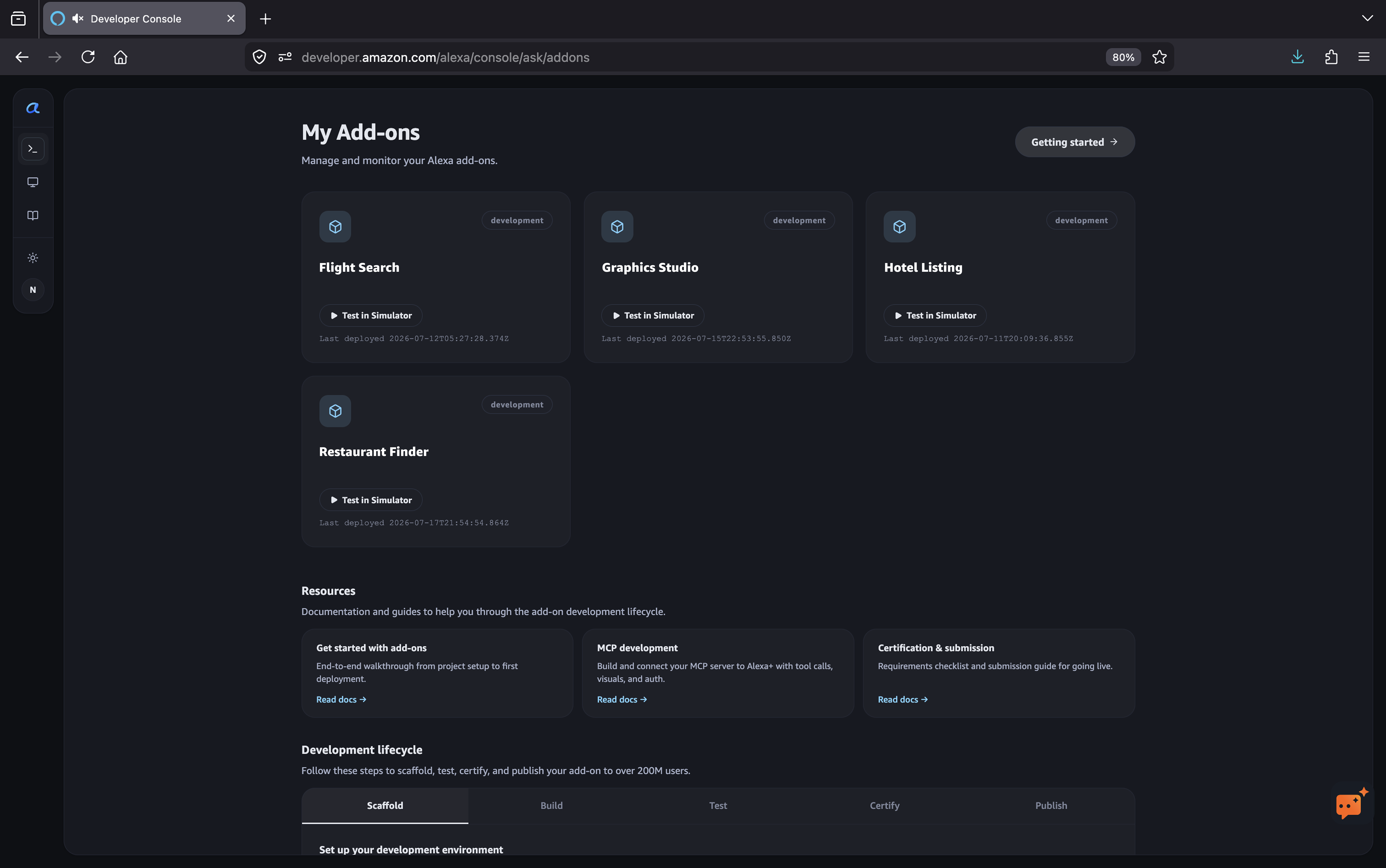
Once deployed, your add-on is available in the development stage. You can do the following:
- Test your add-on using the web simulator or on a physical device (see Test Your MCP Add-ons).
- Make changes to
addon.jsonand redeploy withalexa-ai deploy. - Submit for certification when ready with
alexa-ai submit.
If you modify tools, configurations, or other details in your MCP server, redeploy your add-on with alexa-ai deploy. Alexa+ refreshes tool information only on deployment.
The developer console shows your current add-ons.
Related topics
- Alexa+ MCP Overview
- Alexa+ MCP Client and App Lifecycle
- Alexa+ MCP Design Guide
- Test Your MCP Add-ons
- Authentication
Last updated: Jul 10, 2026
